
Buying guides
Read size charts against clothes that fit
A familiar size label is a starting point, not a measurement. Before choosing, identify whether a chart describes your body or the finished garment. A body chest measurement and a garment chest measurement answer different questions; comparing the numbers without checking the heading can…
A familiar size label is a starting point, not a measurement. Before choosing, identify whether a chart describes your body or the finished garment. A body chest measurement and a garment chest measurement answer different questions; comparing the numbers without checking the heading can mislead.
Start with a useful reference
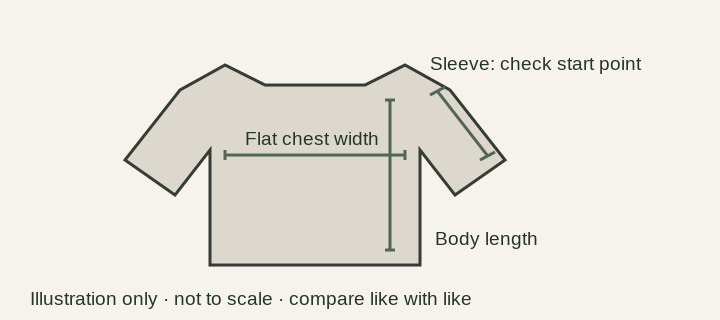
Choose a garment whose fit you like for the same job. A shirt worn under a jacket is a different reference from an overshirt worn over a sweatshirt. Lay the reference flat without pulling it and note where each measurement begins and ends. Keep the method with your numbers rather than saving an unexplained “chest” value.
A flat width across a garment is not automatically a body circumference. If a chart uses a flat measurement, compare it with the same flat measurement on your reference. If the chart does not explain its method, leave that uncertainty open instead of converting the number into an exact fit promise.
Compare the dimensions that affect your routine
For tops, look for chest width or circumference, shoulder position, sleeve length and body length. Check whether sleeve length starts at a shoulder seam or another point. For trousers, separate waist, rise and inseam; the same stated waist does not establish the same seat, thigh or leg opening. For shorts, compare inseam separately from waist.
Write down what you want to change relative to the reference: more room for a base layer, a shorter torso, a different sleeve length or a different leg shape. “Regular,” “slim” and “relaxed” are descriptions to investigate, not universal dimensions shared by brands.
Treat stretch and review themes carefully
A fiber blend alone does not tell you how far a finished garment stretches or whether it returns to its original shape. Do not subtract room from your preferred measurements solely because a listing mentions stretch. Similarly, “runs small” in a review pool may refer to another size, color, pack or personal preference.
Use conflicting reports as a prompt to inspect the exact chart and variant, not as an automatic instruction to size up or down. A model’s height, photographed size and pose do not measure the garment delivered to you.
A five-question size check
- Is this chart for the exact product and option?
- Does it describe a body or a finished garment?
- Can I reproduce the measurement method on my reference?
- Have I compared the dimensions that matter for this use?
- Which measurements or tolerances remain unknown?
Keep the actual care label in the decision too. A fit you like before washing is not a verified fit after repeated care. Do not assume shrinkage will fix a loose garment or that a favorable washing report guarantees your result.
Practical clothing guides
Build a wardrobe around real routines
Start with the week you actually have, not a universal list of essentials. Note the situations you dress for, the layers you use and the care tasks you are willing to repeat. A useful wardrobe is one whose pieces suit those choices; it does not need a prescribed item count.
Read size charts against clothes that fit
A familiar size label is a starting point, not a measurement. Before choosing, identify whether a chart describes your body or the finished garment. A body chest measurement and a garment chest measurement answer different questions; comparing the numbers without checking the heading can…
Understand fabric, care and construction
Begin with the exact option’s fiber-composition and care information. A product family name, a marketing label and a fabric-content row are not interchangeable. If a color changes the blend, use the selected color’s information rather than a percentage from a neighboring option.