
Buying guides
Build a wardrobe around real routines
Start with the week you actually have, not a universal list of essentials. Note the situations you dress for, the layers you use and the care tasks you are willing to repeat. A useful wardrobe is one whose pieces suit those choices; it does not need a prescribed item count.
Start with the week you actually have, not a universal list of essentials. Note the situations you dress for, the layers you use and the care tasks you are willing to repeat. A useful wardrobe is one whose pieces suit those choices; it does not need a prescribed item count.
Map the situations first
Separate everyday casual time, work, occasions and activities with particular clothing requirements. Check the real dress code rather than assuming that a polo, dark jeans or a button-down is accepted everywhere. Decide which situations can share pieces and which need a separate option.
Write a short job for a possible addition: a shirt that fits under your jacket, trousers with a preferred leg shape, or a front-opening layer. This makes fit, fabric, closure and care requirements easier to compare than a vague search for something “versatile.”
Build combinations from what already works
Use a top, bottom and optional layer you already like as a reference combination. Change one component at a time when considering another piece. A color diagram or flat layout can suggest a combination, but it is not evidence of how the clothes fit together on a person.
Compare actual dimensions where available. Sharing a Large label does not establish that a sweatshirt will fit under a Large jacket. Think about sleeve room, torso length and the layers you plan to wear, keeping missing measurements explicit.
Include the care cycle
Consider how often you are willing to wash or otherwise care for each piece, where it can dry, and which instructions you can follow. A hand-wash-only sweater and a machine-wash top may serve similar visual roles but ask different things of your routine. Do not assume one fabric needs the same care as every garment with that fiber.
Plan repeats around your own use and available clean clothing. There is no verified universal number of shirts, trousers or pairs of socks that fits everyone’s schedule. Avoid buying extra options solely because a bundle is large; verify the actual pack and whether each option serves a use.
A practical addition checklist
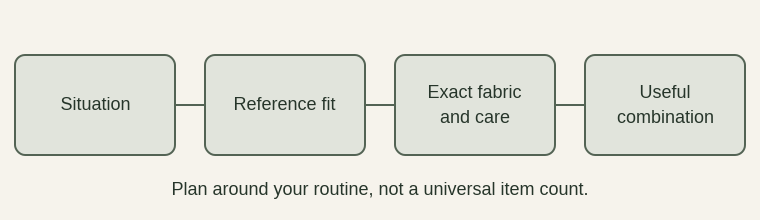
- Name the situation the piece will serve.
- Compare its fit with a reference garment.
- Check the exact variant’s composition and care.
- Identify at least one combination with what you already use.
- Review reported drawbacks and the measurements still unknown.
- Leave unsupported performance, lifespan and warranty claims out of the decision.
Keep a short note after receiving a garment: what fit you liked, what you would change and which care instructions apply. Your own observations can improve the next choice without turning a single experience into a guarantee for everyone else.
Practical clothing guides
Build a wardrobe around real routines
Start with the week you actually have, not a universal list of essentials. Note the situations you dress for, the layers you use and the care tasks you are willing to repeat. A useful wardrobe is one whose pieces suit those choices; it does not need a prescribed item count.
Read size charts against clothes that fit
A familiar size label is a starting point, not a measurement. Before choosing, identify whether a chart describes your body or the finished garment. A body chest measurement and a garment chest measurement answer different questions; comparing the numbers without checking the heading can…
Understand fabric, care and construction
Begin with the exact option’s fiber-composition and care information. A product family name, a marketing label and a fabric-content row are not interchangeable. If a color changes the blend, use the selected color’s information rather than a percentage from a neighboring option.